
Table of Contents
Introduction
Traditionally, SEO has always been seen as a complex, vast, and sometimes mysterious practice. Due to this complexity, many elements of SEO can lead to confusion and differing beliefs.
Search engine optimisation has always been open to debate; not everyone will agree with what it entails, what Google is actively rewarding and where technical SEO stops and development begins.
With the web full of misinformation, there are people in this industry who present their beliefs as concrete facts on what needs to be done.
So, how do you know which ones to trust if you’re just starting out? In this post, Sydney freelance SEO consultant Tom Walker debunks 12 of the most persistent SEO myths that are still circulating in 2025.
Myth #1: SEO Is a One-Time Effort
- Explanation: People who are not that familiar with how search engines work sometimes believe that once a website is audited and optimised, it no longer needs any work. Some also believe that rankings can be maintained indefinitely.
- Myth Type: Strategy
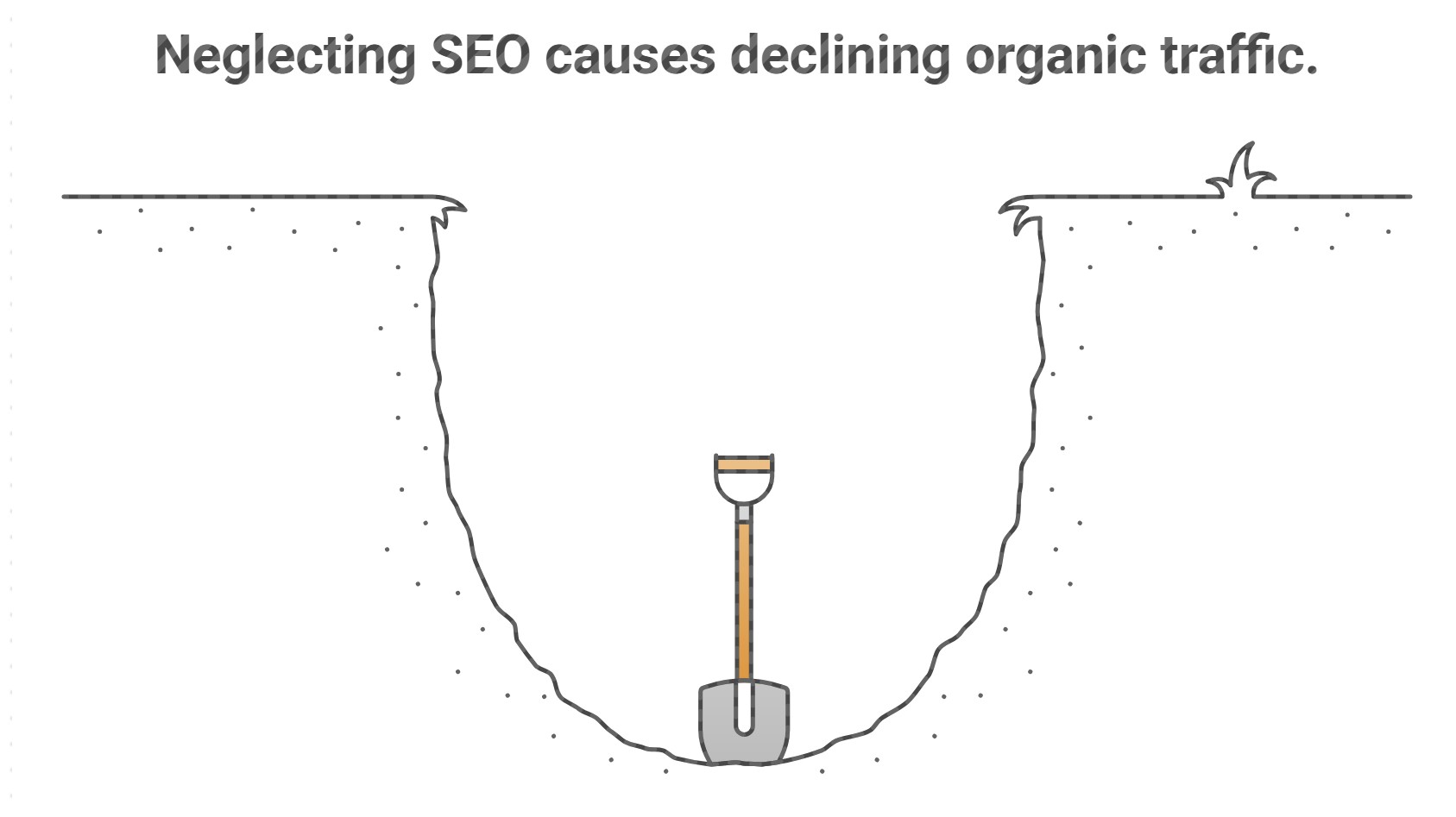
- Why This Is Wrong: The truth of the matter is that this hasn’t been the case for a very long time. As the world has continued to evolve with tools such as artificial intelligence, the online space has continually become more and more sophisticated and therefore much more competitive. In fact, studies such as the one from Ahrefs have shown that neglecting SEO efforts can lead to a gradual decline in organic traffic over time. On top of this, search engines such as Google roll out many updates every year, with some of these being major core updates in an attempt to tackle spam and evolve. These updates can dramatically shift how content is evaluated and ranked in its algorithms. It’s also important to remember that competitors won’t be standing still or idle – they’ll be continually publishing new content, looking to earn new links and improving their site overall to get to the top.
- What Actually Works: Regularly update content, monitor performance, and adapt to changes in search engine algorithms. You can also consider using small business seo experts like Business Medics to assist you.
Myth #2: More Links Always Correlate To Higher Rankings
- Explanation: It is well known that links are a ranking factor within Google’s algorithms, and while the idea of having many links pointing at your website seems like a good idea, not all links are made equal.
- Myth Type: Links
- Why This Is Wrong: This oversimplified thinking ignores the real deal – quality over quantity. Over the years, Google’s algorithms have gotten seriously sophisticated at figuring out the quality and relevance of links pointing at a website. The reality is that one authoritative link from a well-known website is worth much more than hundreds from low-quality directories or blogs. In fact, getting too many links from low-quality sites can actually hurt your rankings – because Google may see it as an attempt to manipulate the search results.
- What Actually Works: The old advice still stands. Avoid the temptation of paying for links and focus on obtaining high-quality backlinks from reputable, trusted sources within your industry. That means creating content that’s genuinely good enough that other people will want to reference it. You can also look at building relationships with other websites and journalists, and chasing up strategic partnerships.
| Opportunities By Website Type | Aim |
|---|---|
| Major National News Outlets (e.g., 9News, news.com.au ) | Boost brand credibility and SEO rankings. |
| Media Contact Platforms (e.g., SourceBottle, GetTheWordOut) | Earn expert quotes and timely media coverage. |
| Industry Trade Publications | Establish thought leadership in your sector. |
| Complementary Australian Businesses | Co-market products and share lead generation. |
| Niche Australian Blogs/Communities | Guest post and access an engaged community. |
| Government/Industry Bodies (e.g., Austrade) | Gain public trust as a vetted provider/partner. |
To summarise: Building links is one of the hardest things in SEO and can be a slow and painful process, but at the end of the day, a handful of high-quality links will always be more beneficial to you than hundreds of poor-quality ones. Once you’re at the top, another Ahrefs Backlink Growth Study has shown that top-ranking pages tend to acquire backlinks more quickly because they are already ranking high, creating a cycle which is the icing on the cake!
Myth #3: Keyword Stuffing Improves Rankings
- Explanation: This was an age-old practice where people would cram as many keywords as possible into content, headers, meta tags, and even hidden text to try and rank higher in search results. Some believe that the more times a keyword appears on a page, the better it will rank.
- Myth Type: Content
- Why This Is Wrong: This is an outdated tactic from the early days of SEO that can actually get you penalised. Having said that, and on a side note, I’ve seen firsthand that it’s worked for some websites when skillfully implemented and has actually helped sites slip past Google’s spam detection algorithm, SpamBrain. This is, however, a risky business, and I would never recommend these practices, as it is not guaranteed to work forever.
- What Actually Works: Use keywords naturally and strategically throughout your content. Always prioritise your copy for a ‘humans first’ approach over search engines. Remember to use your main keywords in places like your title tag, H1, and have them naturally placed in body content, but resist forcing them in.
- Remember: Keyword stuffing = a terrible user experience. Google’s main priority has always been to rank content that is genuine, helpful and actually adds value to the user. Focus on creating content that meets this criteria, answering the user’s queries while adding keywords naturally.
Myth #4: Meta Keywords Are Crucial for SEO
- Explanation: Many people still believe that filling in the meta keywords tag in their website’s HTML will give them a boost in Google rankings. Some use AI tools to carefully select and list their keywords in the hope that it’ll make a difference to their SEO.
- Myth Type: Strategy
- Why This Is Wrong: Meta keywords haven’t been used for a very long time and are officially obsolete for SEO. Due to black hat tactics (techniques used by people to manipulate search engine rankings), major search engines began to disregard them, with Google officially announcing they were no longer used as a ranking factor as of 21st of September 2009, as did Yahoo. Bing later did the same in 2014. This has been confirmed by two well-known people within the SEO community, Matt Cutts and John Mueller.
“Just to be clear from the start, the answer is still no. We do not use the contents of the keyword meta tag in Google Search.” — John Mueller (March 2022)
- What Actually Works: When it comes to metadata, put more effort into what really makes a difference in 2025. Title tags are still a ranking factor, so use catchy titles in your copy that incorporate your keywords naturally. Meta descriptions, while not a direct ranking factor, heavily influence click-through rates if written well. Finally, focus on your H1 tags too while making sure your actual content is well-structured in a logical way.
Myth #5: Social Media Directly Affects Rankings
- Explanation: It has been a common belief that the number of likes, shares, and retweets on X that your content receives directly boosts your search engine rankings. The other misconception is that if you go viral on social media, your website will automatically gain traction in Google’s search results.
- Myth Type: Off-Page SEO
- Why This Is Wrong: Due to the strong correlations between content ranking well and being shared a lot on social media platforms, this has often been thought to be a ranking factor. The link was often so strong that Google has had to repeatedly debunk this myth. It is important to remember that a majority of content on social media platforms is often behind login walls or set to private, making it difficult for search engines to reliably crawl and measure its impact. Secondly, many platforms use nofollow links, meaning that posts do not pass value. Google’s John Mueller cleared this up in a hangout video, where he says:
“So it is not that there is any kind of ranking affect their. To a large part, social networks also have a nofollow on the links that they kind of provide when they post. So it is not the case that that would give you any kind of ranking boost there.“ — John Mueller (March 2022)
- What Actually Works: Think of social media as an indirect SEO benefit rather than a direct ranking factor. While it does not provide a direct ranking boost, social media still has real value for your overall marketing strategy and acts as another form of validation. If you receive many shares and likes, this helps amplify brand visibility, which can lead to more people linking to you.
Myth #6: Longer-Form Content Always Ranks Better
- Explanation: There is an idea that writing longer articles (often 2,000+ words) will automatically outrank shorter content.
- Myth Type: Content
- Why This Is Wrong: While it’s true that longer, in-depth content often ranks well, the oldest phrase in the SEO playbook still applies to this day: quality over quantity. Search engines will naturally prioritise content that is well-written and genuinely helpful to the reader, as covered in Google’s own guidelines. In fact, there is and never has been a word count target that you need to hit. Think about it this way: if you’re searching for a guide on “how to boil an egg”, do you really think you want to read a guide in excess of 3,000 words? The modern user is impatient, and covering absolutely everything on eggs, such as the ‘history of eggs’ in long-form copy, is only going to hurt your article’s engagement rate.
- What Actually Works: What Actually Works: Remember, quality will always win over quantity, simply because it’s more likely to resonate with your target audience. Look at what’s currently ranking for your target keyword and analyse how deeply your competitor articles cover the topic to outrank them. Resist artificially inflating your word count with fluff, as it will hurt your efforts in the long run, not help them.
Myth #7: Spelling and Grammar Errors Will Tank Your Rankings
- Explanation: The belief that having spelling or grammar mistakes on your website will result in direct ranking penalties from Google, causing your pages to plummet in search results.
- Myth Type: Content
- Why This Is Wrong: Google’s John Mueller has said that Google does not penalise poor grammar when ranking pages, but rather it is considered a grey area. More likely, it is connected to other metrics that Google looks at, such as engagement rate. If, for example, your copy is covered in grammatical errors, users (and even Google itself) may struggle to understand the context of the topic, causing it to fall out of favour as a credible source of information. Bad grammar is a signal of low-quality content, meaning it is directly linked to Google’s search quality rater Guidelines, where it says: “Does the content have any spelling or stylistic issues?
John Mueller (2022):
With regard to spelling errors, grammatical errors, I think that’s something that’s a bit more of almost like a gray zone in that on the one hand we have to be able to recognize what a page is about.
And if we can’t recognize that because there’s so many errors on the page in the text, then that makes it harder.
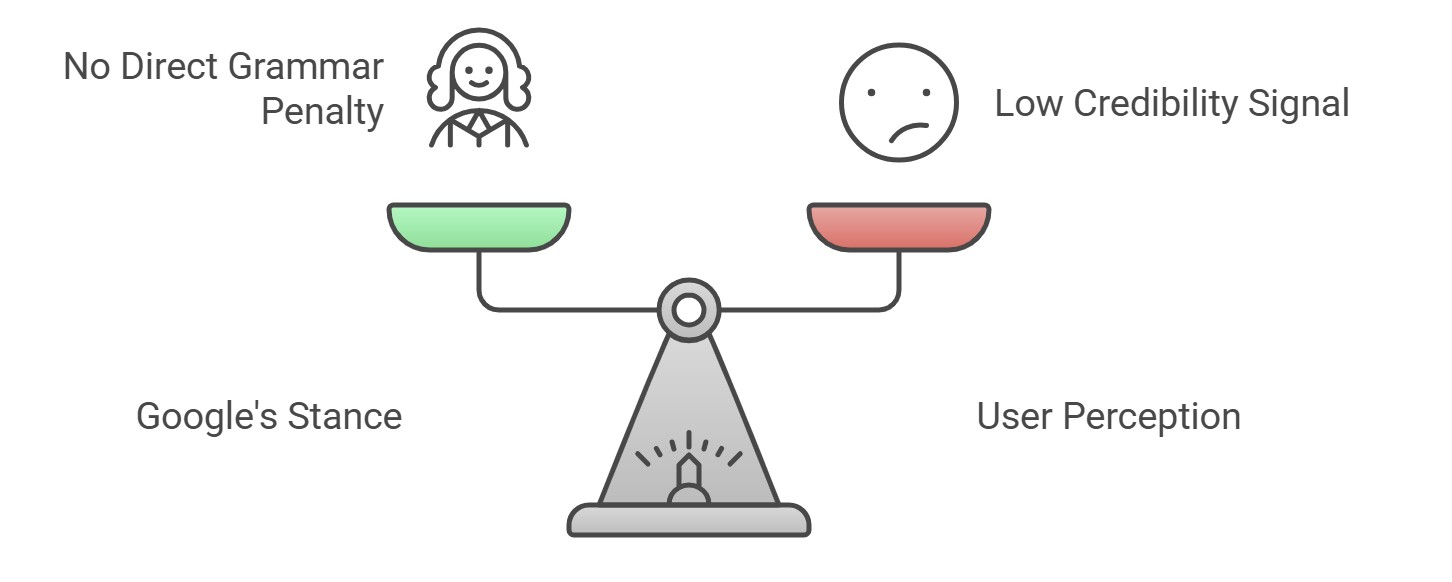
- What Actually Works: While you won’t get a direct penalty for the occasional typo, clear, well-written content appears to be a direct and core component of its EEAT algorithm. For this reason, maintaining high standards for spelling and grammar is still important. This will indirectly support your SEO efforts through better engagement and lower bounce rates.
Myth #8: Google penalises sites for duplicate content
- Explanation: The widespread belief that having duplicate content on your website, whether it’s repeated blocks of text, multiple URL variations, or similar pages direct penalty from Google that negatively affects your rankings.
- Myth Type: Content
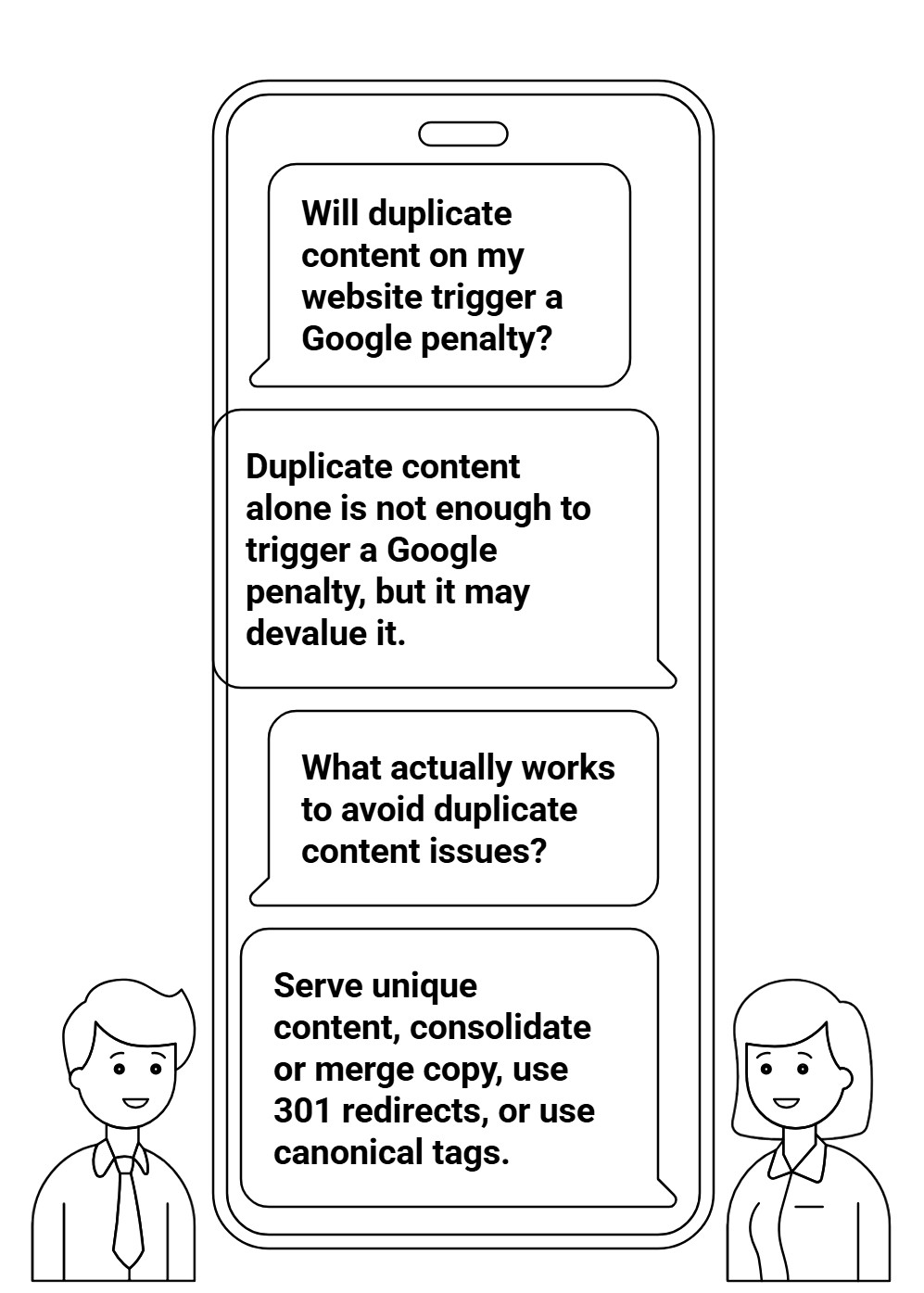
- Why This Is Wrong: This is a heavily debated topic in the SEO community. Duplicate content alone is not enough to trigger a Google penalty, but it may devalue it. The search engine giant has made it clear that the vast majority of duplicate content cases are unintentional. Examples include:
- HTTP vs HTTPS variations
- www vs non-www pages
- Websites that use URL parameters or ‘printer-friendly’ versions of pages.
- Trailing and non-trailing slash pages.
- Different country pages
Most of these examples are instances of common technical issues that an SEO agency will most likely pick up. While duplicate content won’t get you penalised, it can confuse search engines, as this may present a dilemma on which version to show in search results – and that choice might not be the page you wanted. This causes ‘cannibalisation‘ issues, which can impact visibility and unnecessarily diversify your link equity across multiple pages instead of consolidating it on one authoritative version
- What Actually Works: As sophisticated as Google is, it’s always best to serve content that is unique to avoid confusion and cannibalisation issues. Fortunately, duplicate content issues can be addressed by consolidating or merging your copy or by using 301 redirects if needed. Alternatively, you can consider using ‘canonical tags’ to tell Google which one is the preferred version. The takeaway here is, present your copy as clearly as possible to avoid any issues.
Pro Tip:
Avoid copying and pasting other people’s content word-for-word. Not only is this against Google’s spam policies , but it is also a copyright infringement. Your work should always be your own otherwise it risks being penalised. On the flip side, if you suspect someone has copied your work, use the Copyscape plagiarism checker.
About the Author: Tom Walker
Tom Walker is a freelance SEO consultant in Sydney and the owner of Business Medics Australia. With over 15 years of experience, Tom has been heavily involved in SEO campaigns for leading brands globally.
Before launching Business Medics, Tom built up his expertise at established agencies in the UK and Australia. Today, he leverages his wealth of knowledge to help small and medium-sized businesses grow online through transparent, thought-led SEO strategies.
Other websites: thomas-walker.com