
First Published: January 2026 |
Read Time: 12 min |
Covers: SEO ROI • Channel Comparison • Industry Returns • AI & AEO • Hyperlocal • Professional Services
Table of Contents
Introduction – The Considerations
For many people who consider Sydney small business SEO services, the most obvious questions they tend to ask are:
- What return will I get from my investment?
- Can I reach the top of Google?
- Is seo still worth it?
As a business owner, you’ve probably debated this countless times, digested conflicting videos or articles, or gotten lost in multiple Reddit threads while agency sales teams throw confusing jargon with false promises at you.
Wouldn’t it be so much better to get to the crux of it all and look at some real numbers?
The key thing to remember is that it’s not just about “ranking higher in Google”, it’s whether all that time, money & effort is going to pay off and give you a decent ROI (return on investment). Let’s dive in and take a look at what the data really has to say about the value of Sydney SEO for small businesses.
Key Takeaways:
SEO remains one of the most affordable and vital elements of growing small businesses in 2026. Case Studies like this one have shown an average return on investment of 400% after two years.
2026 is about AI + traditional search: You’re no longer just optimising for Google’s blue links. Success means being the business AI assistants recommend while maintaining strong traditional SEO fundamentals.
It’s not a quick fix: Search engine optimisation is a marathon, not a sprint. Results aren’t immediate. It requires dedication, hard work, and results (if done correctly) can take some time to show.
Execution separates winners from losers: Most SMBs lack the 20+ hours weekly needed for proper execution; bringing on professional help can make the difference.
What Factors Might Impact My ROI Through Small Business SEO?
Before you get overly excited, it’s important to note that not every small business is going to see the same results from doing SEO. Many variables can make or break an SEO campaign, including:
1. The Agency You Choose (Experience and Passion Count for a Lot): Not every SEO agency is created equal – it’s as simple as that. Just like in any industry, there are highly experienced and passionate SEO experts like Tom Walker and less experienced ones. An SEO agency that genuinely cares about its clients and has an expert understanding of your growth goals will outshine those that take shortcuts or where you’re considered just another number.
2. How Competitive Your Industry Is: Getting to the top of search results for something straightforward like “best lawyer in Sydney” is a whole different ball game compared to longer tail keywords like “affordable divorce lawyer in Bondi”. There’s a lot of competition out there, and most industries have some pretty established players by now. So, you might need to put in a bit more effort and resources to get anywhere. Furthermore, the more competitive the industry, the more time you may have to dedicate in order to achieving positive results.
3. Google’s Algorithm Changes: Google continuously refines its search engine through algorithm updates to stay ahead of spammers and technological advances. These have been known to break or make or break websites. Most of these updates fall into:
- Minor Tweaks: Just minor shifts in the search results, nothing too out of the ordinary.
- Major Changes (Or Core Updates): These can have a really big impact on your rankings and cause a lot of upheaval.
- Unannounced Changes: Sometimes, search result volatility increases without warning. This can be an indication of changes made by Google, which doesn’t warrant an announcement.
| Update Name | Date | Duration |
|---|---|---|
| December 2025 core update | 11 Dec 2025 | 18 days, 2 hours |
| August 2025 spam update | 26 Aug 2025 | 26 days, 15 hours |
| June 2025 core update | 30 Jun 2025 | 16 days, 18 hours |
| March 2025 core update | 13 Mar 2025 | 13 days, 21 hours |
SEO vs. Other Marketing Channels: A Clear Comparison
It’s no coincidence that almost over 69% of businesses consider investing in search engine optimisation services.
Studies such as this one from HubSpot have consistently shown that SEO continues to deliver higher, longer-term returns on investment, as it’s more sustainable than other marketing channels and is more cost-effective, unlike paid ads, which stop delivering the moment your budget runs out.
While PPC offers instant results, research shows that organic search results are clicked more frequently and are perceived as more trustworthy by consumers than paid advertisements.
The table below breaks down how SEO stacks up against other common marketing channels for small businesses:
| Marketing Channel | Average ROI | Break Even | Key Insights |
|---|---|---|---|
| SEO (Organic) | $8–$10 per $1 | 6–12 months | High ROI. Sustainable traffic; continues even if spend drops. |
| Google Ads | $2–$3 per $1 | Immediate | Fast Results. Traffic stops instantly if budget ends. |
| Meta Ads | $1.2–$6 per $1 | Weeks to months | Targeting. Great for awareness; ROI depends on creative. |
| 36:1 (3600%) | Immediate | Highest ROI. Best for retention and repeat sales. |
Sources:
- Acoustic (2025) Acoustic Unveils 2025 Marketing Benchmark Report
- EmailMonday (2024) Email Marketing ROI Statistics: The Ultimate List for 2026
- Podium (2023) Facebook Ads ROI: Keep Track of Your Investment
- Torro (2023) How Long Does It Take for Google Ads to Become Profitable?
- ChannelSight (2023) eCommerce Google PPC Management Tips
Which Industries Benefit From Higher ROI With Search Engine Marketing?
Just like when you are considering an SEO agency, there are many variables on which industry niches stand the best chance of generating income for their businesses through search engines. Some of the many factors include how much competition there is in the market, what customer behaviours are like, which products have higher search volume and which markets have evolving search trends.
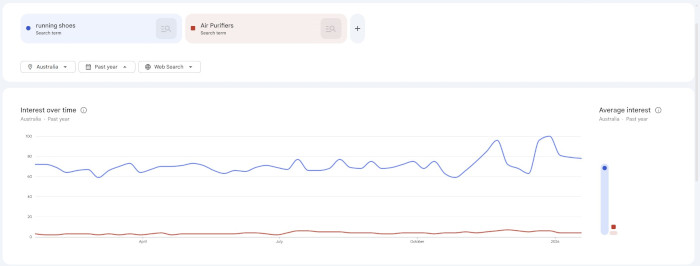
For example, you can see here that in 2025, we can clearly see that there was considerably more search interest in running shoes than in air purifiers.
The Data Summarised
Marketing company FirstPage actually covers it quite nicely from their information table:
- Real Estate: Highest ROI at over 1,389%. For every $1 spent, companies got back over $15.
- Medical & Manufacturing: Both broke the 1,000% mark, showing high-value industries see incredible returns.
- Finance, Ed & Energy: Exceed 10:1 ROAS, proving high lifetime value industries benefit massively.
- Construction: Breaks even in just 5 months—impressive since SEO takes ~3 months to kick in.
- Legal Services: Takes roughly 14 months to break even, often due to longer sales cycles.
- eCommerce: Still solid at 317% ROI, despite heavy saturation and easy-to-build platforms.
The bottom line? All industries in this data set achieved positive ROI, with the worst still returning a healthy $3.65 for every dollar spent. This shows that SEO’s potential across different sectors is still worth the investment. But knowing it works and actually making it work for your Sydney business are two very different things. Here’s how to bridge that gap:
Turning These Numbers Into Reality: Your 2026 SEO Action Plan
Before you begin:
- Get yourself a technical SEO Audit – This will help uncover any glaring issues. You’d be shocked at how much authority is lost through simple inconsistencies.
- Do keyword research – This will better help you target those money terms
- Benchmark your data using tools like Google Analytics and Google Search Console – If you need help with this, we can help.
Your Blueprint Appease The AI Gods
In 2026, SEO and AEO (or Answer Engine Optimisation) are two sides of the same coin. Success lies in understanding that you are no longer just optimising a website, but creating a coherent digital entity.
In other words, your goal should no longer be optimising for those blue links on a results page, but to be the business that the AI recommends for your target market. Here’s a visual breakdown to easier understand:
| Pre-AI 2025 Thinking | 2026 Strategic Imperative |
|---|---|
| Targets higher rankings in Google’s Search Results. | Targets AI assistants to recommend your goods and services. |
| Ensuring basic NAP (Name, Address, Phone) consistency across the web. | Ensuring you are everywhere, not just directory profiles (think social media, conversational platforms, video, podcasts, review platforms and more). |
| Creating general blog content. | Create answer-first, expertise-backed content structured for AI consumption. |
| Claiming your Google Business Profile. | Actively managing all signals that feed the Local Entity Model (LEM) for real-time relevance. |
Things that can help:
Review Your Success With “Zero-Clicks:
AI scrapes data from your website, directories, review sites, and social profiles. You must review how your products, brands, and services appear through AI Overviews, featured snippets, knowledge panels, and local packs. As many users view this information without clicking through to your website, inconsistencies can confuse AI assistants and present inaccurate information to people.
Build Content for AI “Eyes” (and Human Brains):
Make sure your copy serves a dual purpose to appease both users and AI assistants. Ensure that your content is structured in a way that provides clear answers, making it easier for AI to extract information while demonstrating the clear expertise for users to skim read what you are trying to explain. This can be done through the use of hierarchical headers (H2’s or H3’s) and through schema markup. Above all else, clearly demonstrate that you satisfy Google’s EEAT (Experience, Expertise, Authoritativeness, Trustworthiness): AI is increasingly trained to prioritise trustworthy sources.
Go Hyperlocal or Go Home
While it’s admirable to try to take on established businesses for highly competitive keywords like “plumber Sydney”, as a smaller fish, you’ll find better success with hyperlocal SEO tactics.
Definition: Hyperlocal SEO is a highly geo-targeted strategy that focuses on dominating a specific geographic area by building pages for each location. This can be a suburb, a street, or even specific city blocks. The aim is to improve your visibility for locals searching in this area.
What to do: Create speciality location pages and optimise for each hyper-local area you service (think suburbs like Manly, Dee Why and Parramatta), but actually put some effort in & make them genuinely useful to read – try resisting using a template for every suburb it does not always work.
A word of warning: Resist programmatic SEO, or using the templated approach. This is where you use an identical structure, swapping out a few words like the location.
Master Your Google Business Profile
Your Google Business Profile isn’t just another listing to tick off; for local searches, it’s a secret weapon often under-utilised and more valuable than your actual website. It’s the first thing potential customers see when they search for services in their area (and your reviews!).
Definition: Google Business Profile (GBP) is a free tool from Google that allows you to manage how your business appears in Google Search and Maps. You see it all the time, -t’s the information panel that appears on the right side of search results when you look up a business.
What to do: Make sure your Name, Address, and Phone number (NAP) are identical EVERYWHERE they appear online – this means:
- Your own website contact details
- Directory listings (like TrueLocal, Hotfrog, StartLocal)
- Other platforms like Bing Maps.
Inconsistency confuses Google and can impact rankings. Continuously update your profile weekly with posts about what’s happening in your business to keep it fresh.
Solve Customer Problems Through Targeted Content
Small businesses that tend to see real returns are the ones that remain active in their community, satisfying the questions and search intent that their target customers are asking.
Avoid over-reliance on AI as it just regurgitates somebody else’s work, creating generic, unoriginal content. Something unique with insightful stats is what really wins.
Definition: Target market content is material that is created to resonate best with customers you are attempting to attract. This can include text, rich-media and lead magnets like white papers or infographics.
What To Do: Analyse and reverse engineer competitor successes in your niche. See what’s working for them and ‘do it better’. SEO tools like Ahrefs and SEMRush are good for this.
Build Authority Through Search Everywhere Optimisation
While Google still holds a 94% of the Australian search market according to Statcounter, SEO experts have already been discussing noticeable changes in the way users search online.
The reality is that traditional search, as we know it, is experiencing a big shift. Users are no longer relying solely on search engines to satisfy their search queries, but are diversifying the ways they obtain information through various means. This includes social platforms, AI assistants, conversational platforms like Reddit and Quora, watching informational and tutorial videos and listening to podcasts.
Definition: Search Everywhere Optimisation is a fairly new digital marketing strategy that doesn’t just focus on being visible in search engines, but looks at optimising for content using an omni-approach, including:
- Social Media & Video Search
- Reels, YouTube, and LinkedIn
- Targeting AI Assistants Like ChatGPT, Perplexity, And Gemini.
- Optimising For Voice Search In Assistants Like Alexa And Google Home Assistant.
- Optimising For Local Search In Google Business Profiles.
- Being Active In Conversational Platforms Like Reddit And Quora.
- Utilising Visual Search Like Infographics.
Authority And Traditional SEO
While we do recommend diversifying your search presence, it’s equally important not to lose sight of the fact that traditional search still matters a great deal. Building quality backlinks remains a confirmed ranking factor by Google and should not be ignored.
Despite common declarations from people that SEO is dead, new data has suggested otherwise. According to Search Engine Land, organic traffic, in fact, only dropped 2.5% YoY. This is nowhere near some of the claims that people get there, where they were suggesting that organic traffic is forecasted to drop between 25-60%.
From this article, we can deduce that the AI tools like ChatGPT, Perplexity, and other AI overviews are not rapidly replacing traditional anytime soon, as some people have feared.
Get Professional Help From Business Medics

From AI overviews, hyperlocal strategies, Schema markup to ‘Search Everywhere Optimisation’ and GBP management we’re not going to sugarcoat it; SEO takes time.
Most small business owners don’t have 20+ hours a week to dedicate to SEO while also running their actual business. That’s where we come in.
Business Medics specialises in helping small businesses across Australia dominate their local markets without the overwhelm. Whether you’re in Sydney, Melbourne, Brisbane, Perth, Adelaide, or the Gold Coast, we build strategies tailored to your local market.
Our services include:
Small Business SEO Services — Gives your Sydney small business enough ammunition to take on more established businesses without the agency price tag. We’ll handle everything from technical audits to ongoing optimisation.
SEO Consulting — Prefer to keep some control in-house? Work with our founder, Tom Walker. He’ll personally audit your setup, identify quick wins, and build a roadmap strategy with expert guidance.
Content Marketing Services — We create “answer-first, expertise-backed content.” Content that ranks, converts, and demonstrates your local expertise instead of generic AI-generated fluff.
The Final Verdict: Is SEO Worth It?
To wrap up, so is SEO worth it for small businesses in 2025? Well, the proof is in the pudding, absolutely it is!
SEO for small businesses remains one of the most powerful and cost-effective investments you can make to generate sustainable growth. While it demands an upfront investment of time and resources, the long-term payoff means an improved stream of high-quality, ready-to-buy customers.
The businesses that will thrive are those that stop seeing SEO as an optional marketing tactic and start viewing it as the foundation of their customer acquisition strategy. The question is no longer if you should invest in SEO, but when.
About the Author: Tom Walker
Tom Walker is a freelance SEO consultant in Sydney and the owner of Business Medics Australia. With over 15 years of experience, Tom has been heavily involved in SEO campaigns for leading brands globally.
Before launching Business Medics, Tom built up his expertise at established agencies in the UK and Australia. Today, he leverages his wealth of knowledge to help small and medium-sized businesses grow online through transparent, thought-led SEO strategies.