
First Published: February 2026 | Read Time: 12 min | Covers: The Evolving Role of SEO • Traditional vs. AI-Era Strategies • Multi-Platform Visibility • AI Citation & GEO • Voice Search & Answer Engineering
Table of Contents
Introduction – A Fractured Search Engine Landscape
We all now sit in a world where we are leaning on AI more than ever to provide us with answers to our questions and queries.
According to Ahrefs, while Google still processes 13.7 billion queries a day, one of the better-known AI platforms — ChatGPT — is estimated to process around 2.5 billion.
Whether it’s a recommendation for a local plumber in your area or you need a comparison of the best jogging shoes, AI is hugely practical, if not utilitarian, as it goes beyond just searching for results and does the research for you.
Many people in my industry continue to ask if traditional SEO is dead. It’s not! But there is no doubt that the digital landscape has massively evolved.
It’s no longer about aiming for Google’s top spot like in the good old days of traditional search, but more about diversification in getting AI to cite your business over your competitors.
This is where an experienced marketing expert can help.
In this blog post, we provide 8 insightful ways that an SEO consultant can help you strategise in order to future-proof your business and ensure its survivability in an ever-changing online environment.
Key Takeaways:
SEO in 2026 is about more than just Google — and it can no longer be relied on alone: Success now means being visible across the entire web, from AI platforms to conversational communities like Reddit and Quora, using video on YouTube and Vimeo, and maintaining an active social media presence. Focusing solely on Google’s number one spot is no longer a viable strategy.
AI is actively recommending businesses to consumers: Platforms like ChatGPT process an estimated 2.5 billion queries per day, and a growing number of those are recommendation-based. If AI doesn’t know who you are, neither do those potential customers.
Your competitors may already have the edge: Businesses that have invested in GEO, entity building, and AI citation strategies are already being recommended while others are left wondering why their traffic has dropped.
An SEO consultant’s role has fundamentally changed: The best consultants in 2026 don’t just optimise for Google crawlers — they optimise for AI extraction, voice search, and multi-platform visibility simultaneously.
It’s still a long-term strategy: While the landscape has evolved dramatically, SEO remains a discipline that rewards consistency, expertise, and patience over quick fixes.
Key Services: What is an SEO Consultant Exactly?
A qualified SEO consultant is a digital marketing specialist who plays a key role in growing a website’s organic visibility and driving traffic through search engines. In recent times, this role has evolved from ranking a website in Google’s search results to ensuring brands are a trusted source on the internet.
This ranges from optimising for AI platforms such as ChatGPT, Perplexity, Claude, Google’s Gemini, and other models to ensure that all clients’ websites are visible across as many discovery paths as possible (Reddit, TikTok, X, etc.).
Success can no longer be measured by Google’s rankings alone, but by how often you are seen online and across the web and who AI trusts fundamentally.
That said, many of the offerings SEO consultants can help with still apply to this day, and traditional search is still very much relevant.
How The Role of an SEO Consultant Has Evolved SEO
Many of a consultant’s core services still remain similar to those of the last ten years and are still the “engine room” of what it is to maintain a digital presence for searchers. Without these, search engines and AI models have a harder time understanding a business’s website.
As search continues to evolve, so must the job of an SEO specialist. This requires embracing new technology and thinking about an ‘AI-first’ strategy to capture traffic from modern user behaviours:
Comparison Table: Foundational SEO vs The AI & Authority Era
| Traditional SEO | AI-Era SEO (2026) |
|---|---|
| Research & Analysis: From technical audits to keyword research and competitor gap analysis. | Adopting a Multiplatform Strategy: A “search engine everywhere” approach that integrates social media, conversational AI, and video with traditional SEO. |
| On-Page Optimisation: Metadata (titles/descriptions), internal link sculpting, and content optimisation to schema markup. | Entity & Authority Building: Using Schema Markup and “Internal Link Sculpting” to tell AI exactly who you are and what you’re an expert in. |
| Off-Page Growth: From managing Google/Bing Business profiles to social media and link building. | Prioritising Unreplicable, Human-Centric Content: The best-performing content cannot be copied and must feel unmistakably human — personal opinions, first-hand experiences, and data-rich insights. |
| Copywriting: From optimising blogs to ensuring that landing pages are keyword-rich. | Optimising for the World’s Second Largest Search Engine: With approximately 2.70 billion monthly active users, YouTube can build an audience, send traffic and generate leads for your brand. |
| Tracking & Reporting: Helping set up Google Analytics, Google Tag Manager, or Google Search Console to monitor traffic and issues. | Positioning Your Google Business Profile for AI: Using various SEO practices to have AI recommend your business directly from Google Maps. |
| Generative Engine Optimisation (GEO): Structuring content so that AI models cite your brand as the primary answer. | |
| Competitor Gap Analysis (With A Focus On AI): Identifying “content gaps” where competitors are being cited by AI but you are not. | |
| Optimising for Voice & AI Search: Structuring question-and-answer content so that voice assistants and AI models read your business aloud as the recommended answer. |
The 8 Ways An SEO Consultant Can Help Your Business Get Found in 2026
A qualified SEO consultant is a digital marketing specialist who plays a key role in growing a website. Competing for business leads and traffic in 2026 is as complex as ever, especially with so many new tools at businesses’ fingertips.
Gone are the days when you could just rely on one marketing channel, such as search engines. In fact, according to Gartner, traditional search engine volume is predicted to drop by 25% as AI chatbots and virtual agents become substitute answer engines.
A modern search consultant no longer just relies on organic rankings but needs to think outside the box more than ever to capture traffic across every digital touchpoint available.
SEO consultants who are willing to embrace this change and adopt new strategies are the ones who can benefit your business the most. Simply put, a modern SEO expert doesn’t just optimise for Google crawlers or rankings but optimises for ‘extraction’ in order to have AI agents recommend your business in their answers.
Here are 8 ways an experienced SEO consultant can help your business achieve this:
1. Beyond Google: An SEO Consultant Can Mastermind Your Evolution To A Multi-Platform Shift
In 2026, the user journey is no longer linear by nature, but is often seen as a multistep process. Whether this involves users coming through a TikTok post or on X, or finding you through a recommendation from a chatbot like Gemini, there is no longer one domineering marketing channel.
An SEO consultant can help you tap into as many of these sources as possible by helping you with your marketing strategy to capture a larger piece of the digital pie.

Someone with a high level of experience in SEO will also know that traditional search still has a part to play. Data from StatCounter clearly shows that Google still has a commanding 89.87% of the search engine market share, with over five trillion searches every year, according to its official blog.
For this reason, achieving the sweet spot between what’s changed this year and what traditional tactics still work is where an SEO consultant can offer value to your business.
2. They’ll Use Entity SEO As A Powerful Weapon to ‘Prove’ Your Industry Expertise
Having a strong brand is now critical to the success of a business and is just as important, if not more, than just focusing on how many keywords you can rank for. You’ll want to position your business more as an “online entity”. This is known as entity SEO.
What is Entity SEO? In simple terms, it’s about helping search engines and AI models understand who you are, what you do, and why you’re trustworthy — not just what keywords you use. Instead of seeing your website as a collection of pages, they see your business as a verified “entity” with clear expertise and authority, which helps satisfy Google’s E-E-A-T.
One of the many ways to achieve successful entity SEO is through the implementation of schema markup. Launched back in 2011 by search engine giants Google, Bing, and Yahoo, it has been the industry standard in semantic vocabulary ever since and was used by search engines to understand content context and to provide richer and more informative search results.
Now it’s much more than that. It is also used by AI tools to find and trust your content, making them more likely to quote your website as a reliable and primary source of information, goods, or services. This, in turn, will boost a brand’s AI visibility and increase the odds of it being found in voice searches as well.
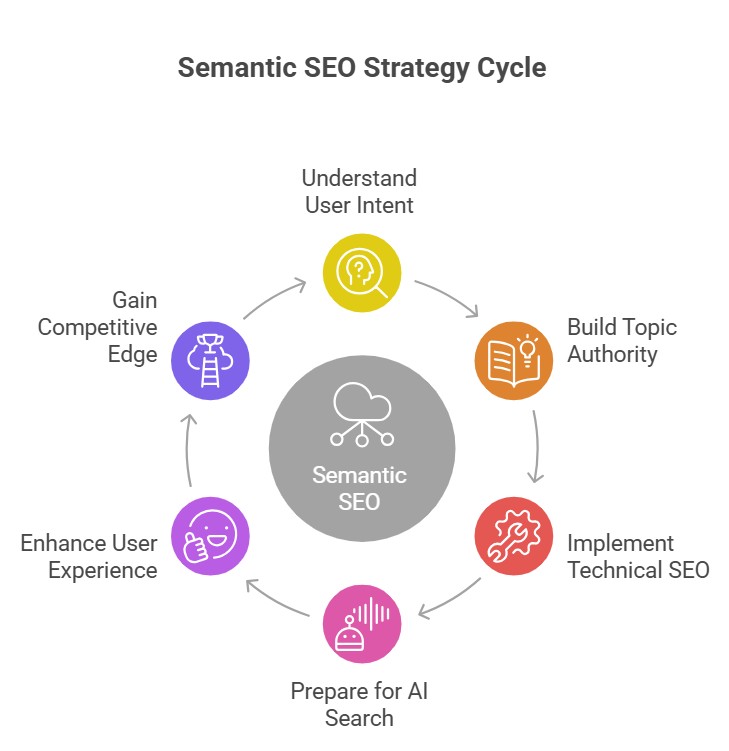
Semantic SEO is essentially how entity SEO is put into practice. Rather than relying on simple keyword matching, search engines now use semantic search to better understand context, relationships, and user intent and an SEO consultant will structure your content accordingly.
It is the practice of producing high-quality content and matching it to the user intent of a search query. It involves careful planning and restructuring copy on a page so it perfectly aligns with how search engines interpret relationships between entities, concepts, and queries.
You can learn more about how this works by reading this blog post.
To sum up, the importance of semantic SEO in 2026 cannot be overstated.
Search engines are continually becoming more sophisticated, and can better understand context, relationships, and user intent much better nowadays. Websites that still rely on traditional keyword optimisation will fall behind, while those that adopt a ‘semantic first’ strategy will be able to capture traffic from hundreds of related search variations that all share similar intent.
This is exactly where an experienced search engine marketing consultant can help.
3. They’ll Add A ‘Human’ Element To Your Content To OutRank AI
First of all, let’s be clear: Google does not actually devalue content simply because it was AI-written. In fact, in Google’s guidelines, there is no statement that highlights this is the case.
Historically, Google’s algorithms have been designed to target low-quality, unoriginal, or unhelpful content, and whether it was created by a human or a machine is irrelevant.
However, human-edited copy can far outrank AI-generated material because it is able to provide first-hand experiences, authentic photography and case studies; not something that has been regurgitated and rewritten from somebody else’s website.
Beyond just Google’s algorithms, nowadays, many people can see through what is AI-generated and what isn’t, which can impact other metrics that Google looks at to rank websites: engagement rates. To put it simply, would you rather visit a site that is authentically written with real ideas, or one that, while it may look perfectly polished, feels generic and ‘normal’?
This is where an SEO expert can help, by guiding businesses to prevent them from falling into the common pitfall where there is an over-reliance on AI to mass-produce blog copy or service pages that offer little value or copy somebody else’s work.
They will help ensure that there is a human element in all content produced, which helps businesses better demonstrate E-E-A-T (Experience, Expertise, Authoritativeness, and Trustworthiness) to gain a ranking advantage over competitors and avoid violating Google’s Spam Policies.
While AI does a good job of restructuring and aiding in visuals, it should never be used on its own. And studies show that Google agrees.
To summarise, businesses should adopt the best of both worlds, where a content expert manually reviews or plans your content strategy and identifies where human expertise and experience need to be layered into AI-assisted drafts. This takes any liability and turns AI into a powerful asset, ensuring your content maintains the authentic human perspective at all times.
4. They’ll Weaponise The Power Of The Second Largest Search Engine: YouTube
Here’s the 2026 edge: embedding YouTube videos doubles the number of keywords for which a page ranks on Google’s first page. Why? YouTube is considered the second biggest search engine after Google and can help to capture audiences at different stages of the buyer journey.
📈 Video increases dwell time by 2.6x and signals deep engagement — and as a Google-owned product, is integrated directly into their search engine result pages.
A consultant identifies your ranking-but-stalling pages and pairs them with short, intent-driven YouTube content — turning visitors into signals.
In other words, by structuring videos around the same topic clusters as your website, consultants help you dominate both in search engines and YouTube by having your videos in video carousels, featured snippets, and organic results simultaneously.
They can also help build a presence within this platform by ensuring your video titles, descriptions and transcripts are all keyword-rich, ensuring your videos are optimised for high engagement and intent purposes.
5. They Help You Connect With Real Customers On Google Business Profile
46%
of all Google searches include a local intent
For this reason, Google Business Profile has always been an excellent platform for attracting leads and connecting with potential customers. With 83% of users using Google to find local reviews (according to Brightlocal’s Local Consumer Review Survey 2026), it is a critical decision-making hub which all businesses should utilise — but the caveat is that it must be handled with care.
Your GBP data now feeds directly into Google’s AI Overviews, so when someone searches for local services, Google’s AI directly pulls from Business Profiles to generate recommendations and answers. This means your profile isn’t just being viewed by potential customers, but it’s being read and cited by AI systems that are making decisions on your behalf.
For this reason, having an incomplete or unoptimised profile in 2026 is no longer an option, especially when users are 2.7x more likely to interact with your profile if it is completely up to date.
More importantly, an incomplete profile means AI systems have less structured information to work with when deciding whether to recommend your business.
An SEO consultant ensures your profile is well-optimised not just for human visitors, but so they appear in Google’s local map packs and in AI-generated recommendations using structured data, consistent NAP (Name, Address, Phone) across the web, and answer-ready content in your business description.
They can also help keep your profile active and fresh by regularly posting on it.
6. They’ll Prepare A Content Strategy To Help You Satisfy GEO
Nowadays, it’s no longer enough to write copy for humans. You need to treat AI agents the same, as more often than not, they are acting on behalf of human readers. This is where Generative Engine Optimisation (GEO) comes in. As a fairly new discipline, this is something many businesses are completely unaware of and should be taken advantage of.
A clued-up search engine optimisation consultant will be aware of this and will understand better than most that AI models actually have limited “attention windows” when extracting facts from your content. To maximise the odds of your business being mentioned in AI Overviews, an SEO expert can help restructure your copy using the inverted pyramid, which is essentially a technique that front-loads the answer, putting it right at the top of your copy.
In other words, every piece of your copy moving forward should start off with a concise and direct answer of around 40 to 60 words, which is designed to steer AI to cite your information. This is then followed by supporting details and evidence. The use of recent statistics, including expert quotes and maintaining confident language, is also important to gain mentions.
All of this can be put together by an SEO expert to satisfy machine readability as part of your overarching strategy, giving you visibility in AI-generated answers whilst your competitors are still wondering why their traffic has dropped.
7. Competitor Gap Analysis (With A Focus On AI)
Studies show that AI models like ChatGPT now handle an estimated 2.5 billion queries per day, and a growing proportion of those are recommendation-based searches where users are actively asking AI to make an informed decision for them. Unlike Google’s classic ten blue links, AI gives one answer — and if your business isn’t in it, you could be missing out on valuable leads.
Back in the day, traditional competitor analysis used to be straightforward: find the keywords your rivals rank for that you don’t, then reverse-engineer their successes and create better, more insightful content to close the gap.
In 2026, that same principle now extends into a far more consequential arena — AI citations. If your competitor is being mentioned by these platforms, it’s because they’ve earned their trust, much like earning a top spot in traditional search. AI scrapes third-party sources it has determined to be authoritative, well-structured, and trustworthy to decide who it should recommend.
An experienced SEO consultant can identify these “AI citation opportunities” — the exact queries and topics where your competitors are being recommended by ChatGPT, Perplexity, Google’s AI Overviews, and other platforms, while your business is nowhere to be found.
8. Tapping Into Voice Search: A Consultant Can Get Your Business Heard – Quite Literally
Voice search is no longer something people do occasionally — it has become deeply ingrained into everyday life. Whether it’s checking step counts on a smartwatch, asking a home assistant for tomorrow’s weather, or querying Google Assistant on the commute to work, there are now roughly 8.4 billion voice assistants in use worldwide, with approximately 33% of Australians using voice search every single day.
This represents a significant commercial opportunity, and it’s one that a skilled SEO consultant can help you capitalise on through a practice known as “answer engineering.”
Unlike typed searches, voice queries are conversational, longer, and almost always phrased as direct questions — think “who is the best electrician near me?” rather than “electrician Sydney.” A consultant who understands this distinction will structure dedicated question-and-answer content around the exact phrases your customers are already speaking into their devices, using FAQ-rich pages, structured data markup, and concise answers that AI assistants are primed to extract and read aloud.
The businesses that treat voice search as a priority today will be the ones quite literally in their customers’ ears tomorrow — before the competition even realises the opportunity exists.
About the Author: Tom Walker
Tom Walker is an SEO consultant in Sydney and the owner of Business Medics Australia. With over 15 years of experience, Tom has been heavily involved in SEO campaigns for leading brands globally.
Before launching Business Medics, Tom built up his expertise at established agencies in the UK and Australia. Today, he leverages his wealth of knowledge to help small and medium-sized businesses grow online through transparent, thought-led SEO strategies.